Hugging Face
VisitWe’re on a journey to advance and democratize artificial intelligence through open source and open science.
What is Hugging Face?
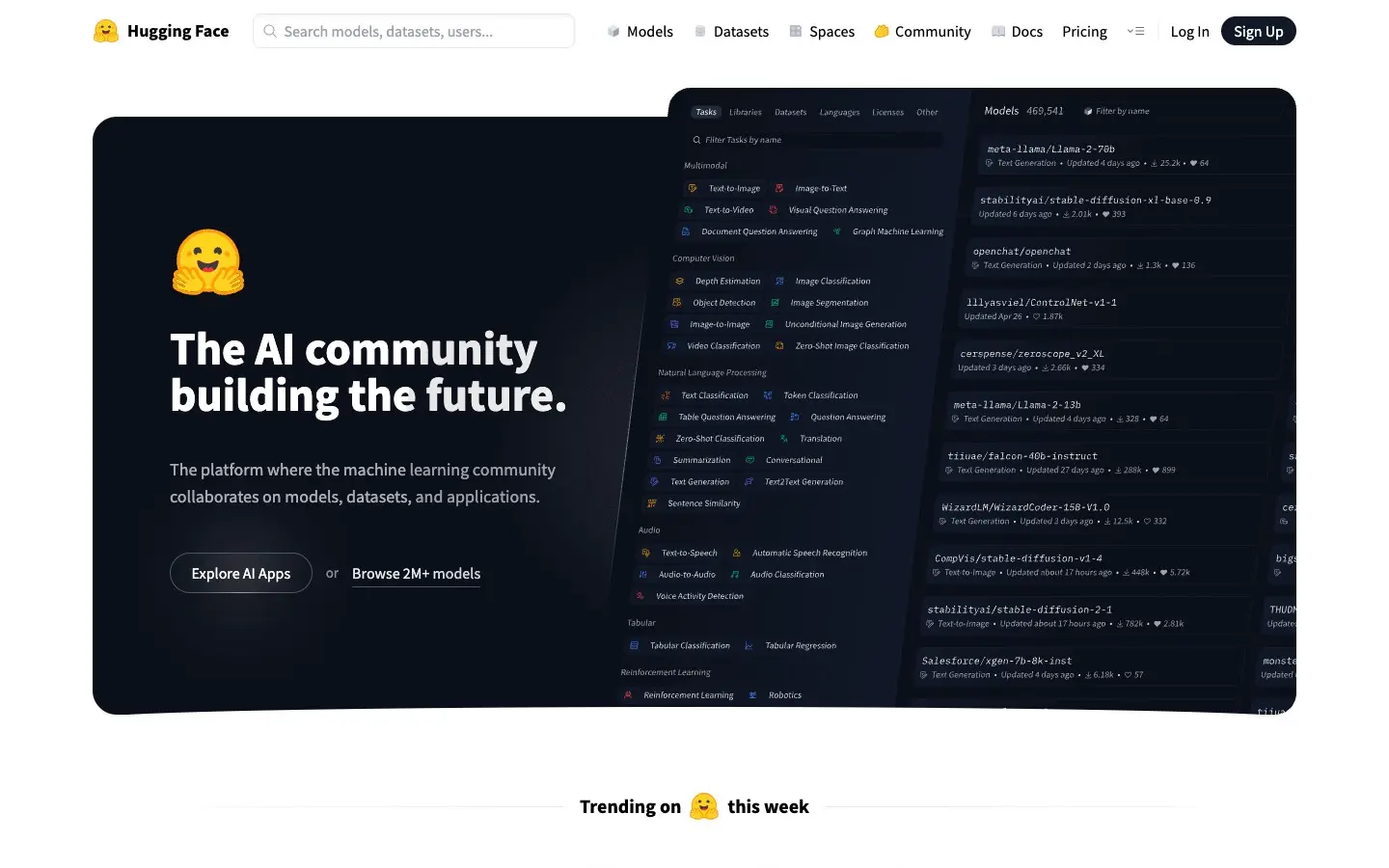
Hugging Face is the premier open-source community and platform for machine learning (ML) and data science. Often referred to as the "GitHub of AI," it hosts hundreds of thousands of pre-trained models, datasets, and demo applications (Spaces). It empowers developers, researchers, and companies to build, train, and deploy state-of-the-art AI models for natural language processing, computer vision, and audio tasks effortlessly.
Core Features
- Model Hub: A massive repository hosting over 500,000 open-source models (BERT, GPT, Stable Diffusion, etc.) ready for download and fine-tuning.
- Datasets Library: Access thousands of diverse datasets for training NLP, vision, and audio models across hundreds of languages.
- Spaces: Easily host and demonstrate machine learning apps directly in the browser using Streamlit, Gradio, or Docker SDKs.
- Transformers Library: The industry-standard Python library for downloading, training, and using state-of-the-art ML models with just a few lines of code.
- Inference API: Deploy models instantly via a scalable, production-ready API without managing infrastructure.
Use Cases
- AI Research & Development: Discover the latest research models, reproduce results, and share new findings with the global community.
- Application Development: Integrate advanced NLP (translation, summarization) or vision capabilities into apps using pre-trained models.
- Education: Learn about machine learning through interactive demos, course materials, and community discussions.
- Enterprise AI: Host private models and datasets securely for internal team collaboration and deployment.
FAQ
Q: Is Hugging Face free?
A: most features, including hosting public models, datasets, and spaces, are free. They offer paid Pro and Enterprise plans for private repositories, higher hardware tiers (GPU), and priority support.
Q: Do I need to know coding to use it?
A: While it is a developer-focused platform, the "Spaces" feature allows non-technical users to interact with and test AI models through user-friendly web interfaces.